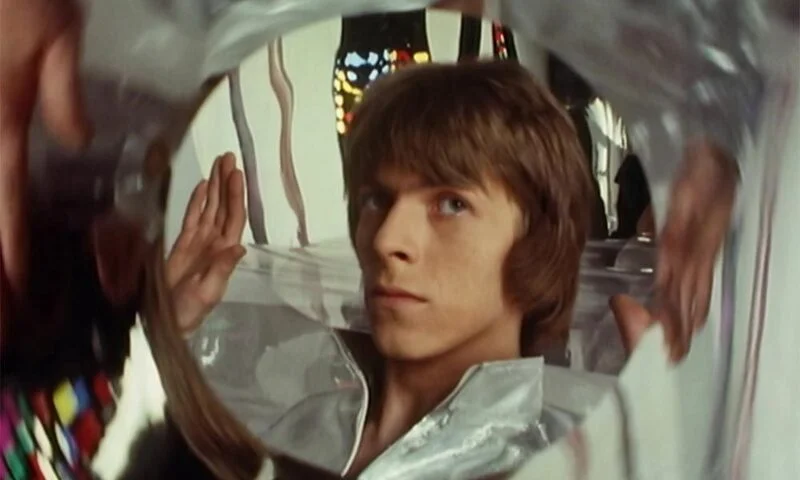
David Bowie’s “Space Oddity” is one of the most iconic songs in rock history, remembered not only for its haunting melody and sci-fi narrative, but also for the mythos that surrounds its release. Often mistaken as a tribute to the Apollo 11 moon landing, the song’s legacy is entangled with a bizarre and widely misunderstood moment in the relationship between pop culture and space exploration.
But behind the sonic drama of Major Tom drifting into the void is a curious tale that involves BBC editors, nervous NASA officials, and a British music industry unsure how to market a melancholic space ballad at the dawn of the Space Age.
The Birth of Major Tom
David Bowie wrote “Space Oddity” in 1968, inspired by Stanley Kubrick’s film 2001: A Space Odyssey, which had premiered earlier that year. While the public was enchanted by Kubrick’s hypnotic visuals and ambiguous storyline, Bowie was fascinated by its emotional tone — particularly the theme of human isolation in a technologically advanced world.
The song tells the fictional story of Major Tom, an astronaut who is launched into space, communicates with Ground Control, and eventually floats away, lost and disconnected. With lyrics like:
“And the stars look very different today…”
…it’s not the kind of anthem one would expect to hear during a national celebration of scientific achievement.
Perfect Timing — Or Was It?
“Space Oddity” was released on July 11, 1969 — just nine days before NASA’s Apollo 11 mission successfully landed humans on the Moon. For many, the coincidence seemed too perfect to be accidental. Indeed, some listeners assumed the song was Bowie’s tribute to the astronauts, a space-age ballad of triumph.
However, the song was never meant to be patriotic or celebratory. Instead, it was existential, eerie, and melancholic. In many ways, it was a critique of space exploration’s emotional toll, wrapped in a sci-fi narrative.
“It was actually a song of alienation,” Bowie later said. “A sense of being utterly alone, even though you’re part of something bigger.”
This stark contrast between tone and timing made what happened next all the more bizarre.
BBC’s Unlikely Decision
As Apollo 11 prepared for liftoff, the BBC was gearing up for its historic live coverage. Yet in a surprising move, BBC producers chose to use “Space Oddity” as part of their broadcast. The haunting track, which ends with Major Tom lost in space, became an unofficial soundtrack to one of the most triumphant moments in human history.
“It was so surreal,” Bowie recalled in an interview. “I didn’t think they’d use it. I mean, the astronaut doesn’t come back!”
The BBC’s decision has been debated ever since. Some claim it was a cheeky nod to the emerging counterculture, while others believe the producers simply loved the track and overlooked its darker implications. Regardless, it catapulted Bowie to wider recognition — not just as a musician, but as a cultural provocateur.
NASA Was Not Amused
While the BBC may have embraced the song, NASA’s reaction was more complicated. The U.S. space agency, known for its conservative image and careful messaging during the Cold War era, reportedly found the song’s bleak portrayal of space travel unnerving.
Although no official public condemnation was made, NASA insiders were said to be displeased with the idea of their groundbreaking mission being sonically accompanied by a fictional astronaut who loses contact with Earth. Some press reports at the time even hinted that NASA discouraged American broadcasters from using the song during coverage of the moon landing.
Whether or not this amounted to a formal “ban” is still debated. What’s clear is that “Space Oddity” was considered too emotionally ambiguous — and perhaps too British — for NASA’s preferred narrative of American triumph.
A Song With a Life of Its Own
Despite the tension, “Space Oddity” went on to become Bowie’s breakout hit. In the UK, it reached No. 5 on the singles chart, largely thanks to the BBC’s moon landing broadcast. In the U.S., however, the song took longer to catch on, initially failing to chart until it was re-released in 1973 — after Bowie had already gained fame through his Ziggy Stardust persona.
The song’s legacy only deepened with time. Bowie revisited Major Tom in several later tracks, including “Ashes to Ashes” (1980), which portrayed the astronaut as a lost soul battling addiction and disappointment. In this sense, Major Tom evolved from a space explorer into a metaphor for human fragility.
The 2013 Space Reboot
Ironically, the song that once unsettled NASA eventually found a home among real astronauts. In 2013, Canadian astronaut Chris Hadfield recorded a cover of “Space Oddity” aboard the International Space Station — the first music video filmed in space. With Bowie’s blessing, Hadfield’s performance went viral, offering a redemptive reinterpretation of the song that once unnerved American space authorities.
“Bowie’s version was about disconnection,” Hadfield explained. “Mine was about humanity’s progress. I wanted to bring it full circle.”
This moment brought the song’s journey full orbit — from symbolic alienation to literal inspiration among the stars.
Why the Controversy Still Matters
The story of “Space Oddity” is more than an amusing footnote in pop culture history. It reveals the tension between art and narrative control — between music that explores human doubt and institutions that seek to project certainty.
In many ways, the song’s controversial use during the moon landing coverage highlights how pop culture doesn’t always serve official stories. Sometimes, it offers a parallel narrative — one that deals with fear, complexity, and emotional fallout. That Bowie’s melancholic track found its way into a moment of collective pride only makes its impact more enduring.
Conclusion: A Strange Orbit
David Bowie’s “Space Oddity” didn’t just ride the coattails of Apollo 11 — it challenged the emotional simplicity of triumphalist narratives. Its bizarre entanglement with NASA, the BBC, and public perception transformed it from an obscure single into a generational anthem.
And though Major Tom may never have made it home, his story continues to resonate — as a symbol of wonder, isolation, and the vast unknown both above and within us.
In the end, Bowie’s cosmic ballad wasn’t just about space. It was about what it means to float alone, disconnected, even in a world that claims to celebrate exploration. That’s what made it powerful. And that’s why, decades later, we’re still talking about it.