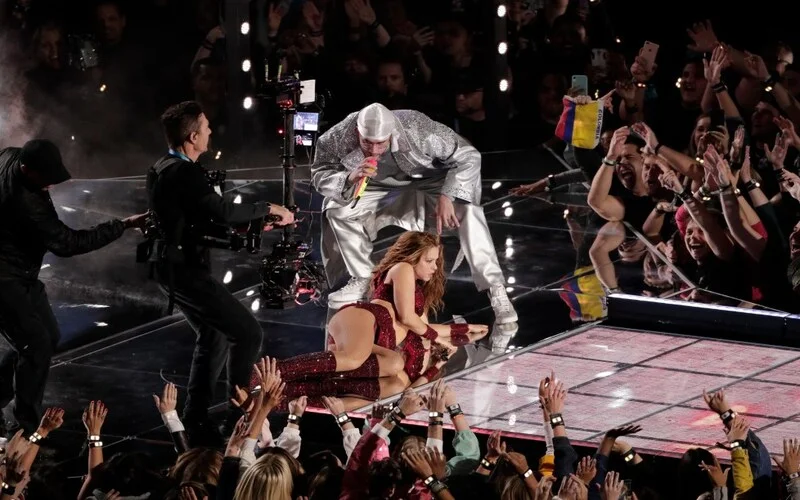
In an industry where manufactured personas often dominate, Bad Bunny’s rise to global superstardom stands out for its authenticity, ambition, and cultural significance. From bagging groceries in Vega Baja, Puerto Rico, to becoming one of the most streamed artists in the world, Bad Bunny—born Benito Antonio Martínez Ocasio—rewrote the rules of Latin music and reshaped the global soundscape.
His journey isn’t just a story of success; it’s a case study in how digital platforms, artistic vision, and unapologetic identity can combine to break boundaries.
Early Life: Humble Beginnings in Vega Baja
Bad Bunny was born on March 10, 1994, and raised in the small Puerto Rican municipality of Vega Baja. Far from the glitz of the music industry, his upbringing was grounded in community, Catholic values, and a love for music. His mother played salsa and merengue in the house, while Benito gravitated toward reggaetón icons like Daddy Yankee and Vico C.
Despite his musical interests, he lived an ordinary life. As a teenager, he worked as a supermarket bagger at Econo, earning just a few dollars an hour. During this time, he studied communications at the University of Puerto Rico at Arecibo and spent his free hours writing lyrics and creating beats.
“I wasn’t in the streets getting into trouble. I was at home, making music and dreaming big,” he later said in interviews.
The SoundCloud Start
Bad Bunny’s first real breakthrough came not through a label, but through SoundCloud. He began uploading tracks in 2015 under the moniker “Bad Bunny,” a name inspired by a childhood photo of him looking angrily into the camera while wearing bunny ears.
His DIY production style—gritty, bass-heavy, and emotionally raw—resonated with listeners. One of his earliest uploads, “Diles,” caught the attention of DJ Luian, a major figure in the Latin trap scene. Luian signed him to Hear This Music, launching Bad Bunny into a wider underground audience.
Breaking into the Mainstream
Between 2016 and 2018, Bad Bunny released a flurry of singles that cemented his place in Latin trap, a subgenre still gaining footing in the mainstream. Songs like “Soy Peor” and “Chambea” became anthems for a generation of Spanish-speaking youth who saw in him a relatable voice—unfiltered, emotional, and stylishly rebellious.
His unique vocal tone, eccentric fashion sense, and lyrical openness distinguished him from other reggaetón and trap artists who often leaned on machismo. He collaborated with established artists like J Balvin, Ozuna, and Arcángel, while maintaining a distinct identity.
In 2018, he made a major crossover with the Cardi B and J Balvin hit “I Like It.” The song reached No. 1 on the Billboard Hot 100, making Bad Bunny a household name in the English-speaking market. His verse, delivered entirely in Spanish, proved that language was no barrier to global success.
Genre-Blending Innovation
Bad Bunny’s first studio album, X 100PRE, dropped in December 2018 and showcased his ability to blend genres seamlessly. The album merged Latin trap, reggaetón, punk rock, and synth-pop, showing a versatility rarely seen in urban music.
Tracks like “Estamos Bien” conveyed optimism amid hardship, while “Caro” addressed gender norms and identity with bold lyricism and visuals. He wasn’t just redefining Latin music—he was challenging the assumptions that came with it.
His fashion and video concepts frequently pushed against gender stereotypes, and he became an outspoken advocate for LGBTQ+ rights in Latin America, a region where such discourse remains sensitive.
Quarantine Stardom: “YHLQMDLG” and Beyond
In early 2020, Bad Bunny released YHLQMDLG (an acronym for “Yo Hago Lo Que Me Da La Gana,” or “I Do Whatever I Want”), which became the highest-charting all-Spanish-language album in Billboard 200 history at the time.
Later that year, during the COVID-19 pandemic, he released two more albums—Las Que No Iban A Salir and El Último Tour Del Mundo. The latter made history as the first all-Spanish album to reach No. 1 on the Billboard 200.
- “Dákiti” with Jhay Cortez became a global smash, topping Spotify charts.
- “Yo Visto Así” challenged conventional norms around fashion and masculinity.
- “Booker T” bridged wrestling themes with hip-hop swagger, showcasing his cultural range.
These releases solidified his status not just as a Latin star, but as a global artist with unmatched reach.
Streaming Era Dominance
Bad Bunny’s rise coincided with the explosion of streaming platforms, which played a pivotal role in democratizing music access. Services like Spotify and Apple Music allowed Spanish-language songs to bypass traditional radio gatekeeping.
In 2020, 2021, and 2022, he was the most-streamed artist on Spotify worldwide. His records weren’t just numbers—they signaled a paradigm shift where Spanish-language music could compete globally without needing English translations or pop collaborations.
His organic rise through platforms also showed the changing nature of artist discovery. He built his fanbase digitally, not through primetime TV performances or major label promotion. This gave him greater control over his narrative and creative output.
Cultural Impact and Social Voice
Bad Bunny has used his platform to speak on political and social issues, particularly in Puerto Rico. In 2019, he joined protests demanding the resignation of Governor Ricardo Rosselló, donning protest gear and marching alongside fellow citizens.
He’s also used music and performances to spotlight violence against women, homophobia, and inequality. His 2020 performance on “The Tonight Show Starring Jimmy Fallon” included a shirt reading, “They killed Alexa, not a man in a skirt,” referring to the murder of a transgender woman in Puerto Rico.
Through his lyrics, fashion, and interviews, Bad Bunny redefined what it means to be a male artist in Latin music — emotionally vulnerable, politically active, and completely himself.
From Bag Boy to Boundary Breaker
Bad Bunny’s journey from bagging groceries to breaking streaming records is not just a Cinderella story—it’s a redefinition of what global stardom can look like in the 21st century. He didn’t conform to industry norms, nor did he wait for permission to speak, dress, or sing his truth.
His story proves that authenticity, digital savvy, and cultural awareness can be just as powerful as traditional talent. By embracing every facet of who he is — Puerto Rican, genre-fluid, fashion-forward, and socially conscious — Bad Bunny didn’t just find success. He changed the rules for how that success can be achieved.
And the best part? He did it all in his own voice — and on his own terms.