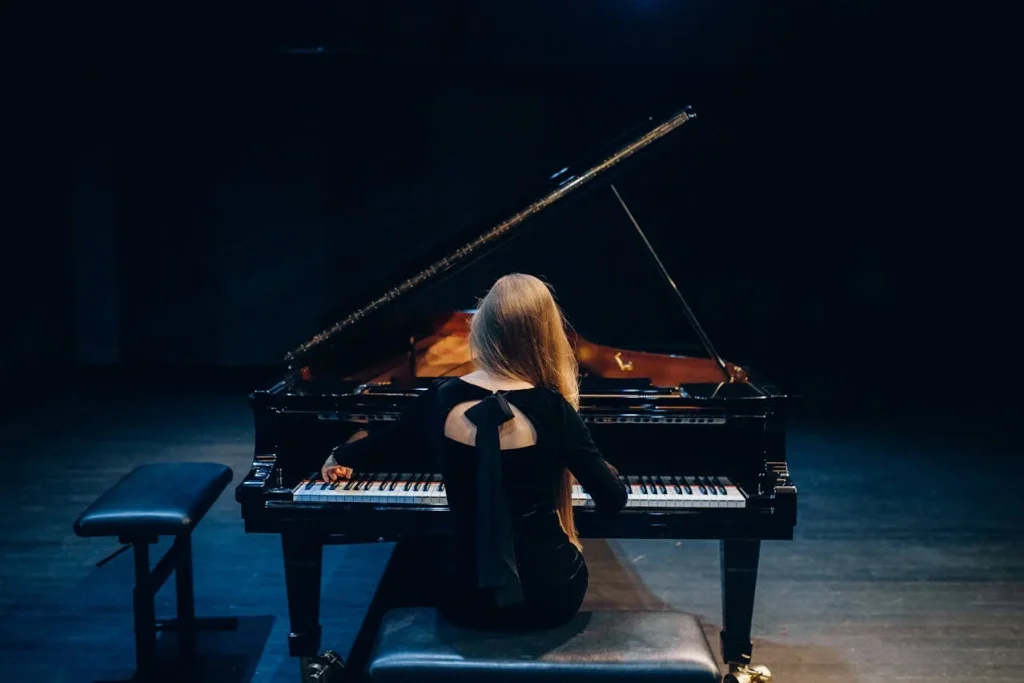
Before the world knew her as a Grammy-winning artist and global icon, Alicia Keys was simply a girl with two big dreams — one shaped by Mozart and the other by Mary J. Blige. Raised in the vibrant chaos of New York City, she moved fluidly between classical music lessons and the gritty rhythm of hip-hop culture, balancing two worlds that rarely intersected.
Her journey from a Harlem studio apartment to the world stage is a story of contrast, resilience, and harmony — both musical and personal. In an environment where survival often trumped sophistication, Alicia carved out space for both elegance and edge, blending the structured precision of classical piano with the raw, unfiltered soul of the streets.
Roots in Rhythm and Rigorous Training
Alicia Keys was born Alicia Augello Cook in the Hell’s Kitchen neighborhood of Manhattan, a melting pot known for its energy and edge. Raised by her mother, Terria Joseph — an actress and part-time paralegal — Alicia was introduced to the arts at an early age. Recognizing her daughter’s fascination with music, Joseph enrolled Alicia in classical piano lessons when she was just seven years old.
For nearly a decade, Alicia studied the works of Beethoven, Chopin, and Mozart, developing a strong foundation in musical theory and technical discipline.
She practiced on an upright piano in the corner of a modest one-bedroom apartment, often blocking out the sound of sirens and street noise to focus on scales and sonatas. That contrast — serene melodies inside, chaotic life outside — would later define her artistry.
The Studio Apartment Soundtrack
Living in Harlem during the 1980s and 1990s meant Alicia was immersed in hip-hop at its cultural peak. She walked past boom boxes blaring Nas and Biggie, and her bus rides echoed with the verses of Wu-Tang Clan and Lauryn Hill. While her fingers trained in classical technique, her ears absorbed the rhythm of New York’s streets.
“I’d finish my Bach pieces and then listen to Biggie in the same breath,” Keys once recalled. “To me, there was no disconnect — it all spoke to me.”
Her small studio apartment was both sanctuary and laboratory. Classical sheet music lay beside cassette tapes. A dusty metronome ticked alongside the percussive loops of drum machines. Keys was quietly creating her own hybrid sound.
Dual Lives at the Professional Performing Arts School
At 12, Alicia earned a spot at Manhattan’s prestigious Professional Performing Arts School, where she majored in choir and honed her vocal skills alongside acting and piano. While most of her peers focused on either academic or artistic achievement, Alicia did both — graduating as valedictorian at age 16.
Her time at the school only deepened the gap between her formal musical world and the gritty beats she loved. Classrooms echoed with arias and jazz standards, while her heart pulled her toward the truth-telling of hip-hop.
Still, she refused to choose. Instead, she internalized the best of both: the storytelling urgency of hip-hop and the emotive power of classical music.
Turning Down Columbia for Creative Freedom
Alicia’s intellect was as sharp as her musical ability. At 16, she was accepted into Columbia University, a dream for many. But she had already signed with Columbia Records — and the schedule of a recording artist didn’t mesh with Ivy League academics.
After one month at Columbia University, Alicia made a life-defining decision: she dropped out to pursue music full-time.
It was a leap of faith that came with risk, especially for a young Black woman blending genres that didn’t always coexist on the charts. But she believed in her voice, her pen, and her piano — and she wasn’t willing to dilute any part of her sound to fit a mold.
Finding Her Voice at the Keyboard
Even as a teenager, Alicia Keys had something rare — a signature style. Her classical background allowed her to write intricate chord progressions and melodies that stood out in a hip-hop-heavy market. Producers often encouraged her to drop the piano, to “modernize” her sound. She refused.
“I’d come in with classical chords and soulful lyrics,” she once said, “and they’d look at me like, ‘Can’t you just do something more urban?’ But I wasn’t trying to follow the formula.”
Instead, she forged her own: hip-hop beats laid beneath piano riffs, gospel-infused vocals layered over streetwise lyrics. It wasn’t just genre fusion — it was identity fusion.
Breakthrough With a Hybrid Sound
When Alicia Keys released her debut album Songs in A Minor in 2001, the music world didn’t quite know how to categorize her. Was she soul? Was she R&B? Was she classical-pop with a hip-hop twist?
The answer was yes to all of the above. And it worked.
The lead single, “Fallin’,” showcased her piano prowess, her expressive vocals, and her love for blues-infused storytelling. The song shot to No. 1, and the album earned her five Grammy Awards — including Best New Artist and Song of the Year.
Alicia didn’t just enter the music scene — she redefined it, proving that complexity, training, and authenticity could coexist in the mainstream.
Staying Grounded in Harlem Roots
Even after her rise to fame, Alicia remained deeply connected to the community and cultural heritage that shaped her. She’s spoken openly about the way Harlem’s energy gave her rhythm, how its contradictions sharpened her perspective, and how its hardships gave her something to say.
She co-founded the organization Keep a Child Alive and has remained active in education and activism — often reminding fans that success without purpose feels empty.
A Harmony of Opposites
Alicia Keys’ story is not just one of musical talent. It’s a narrative about holding space for contradiction — for being both classically trained and streetwise, both disciplined and free-spirited. She didn’t choose between Chopin and Tupac; she found a way to let them speak through the same song.
In a world that often demands either-or, Alicia Keys built a career on both-and. Both the upright piano and the subway cypher. Both the recital and the freestyle.
Her rise from a Harlem studio apartment to international stages wasn’t just a personal triumph — it was a cultural evolution. And in every note she plays, that balance lives on: one hand in the past, the other pushing music forward.