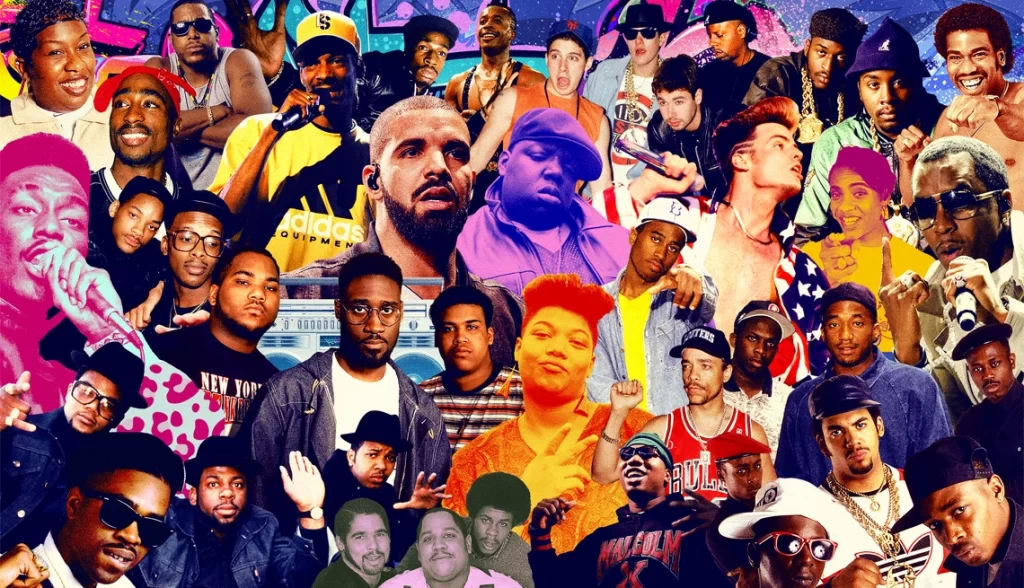
Hip-hop is more than a genre — it’s a movement, a mirror, and a megaphone. Since its birth in the 1970s, hip-hop has served not only as a platform for artistic expression but as a powerful vehicle for social commentary. From block parties in the Bronx to global arenas, the music has evolved into a cultural force that reflects the struggles, hopes, and activism of entire generations.
Over time, hip-hop has repeatedly amplified voices that were marginalized, challenged systems of inequality, and inspired collective action. Here’s how this art form became synonymous with social change across decades.
The Birth of a Movement: 1970s Bronx
Hip-hop’s roots lie in the South Bronx of New York City in the 1970s — a time of economic decline, urban decay, and political neglect. Communities were struggling, and young people, particularly Black and Latino youth, found themselves with few resources and little representation.
With access to little more than turntables, microphones, and open streets, pioneers like DJ Kool Herc, Grandmaster Flash, and Afrika Bambaataa created a new form of storytelling. Hip-hop wasn’t born in recording studios or corporate boardrooms — it was born on sidewalks and in community centers.
In this environment, hip-hop gave people the power to speak when institutions would not listen.
Though much of early hip-hop focused on party culture and local pride, its foundation was inherently political — rooted in survival, resistance, and identity.
1980s: From Celebration to Confrontation
As hip-hop matured, it became a more direct platform for political and social commentary. In the 1980s, artists began to use their lyrics to expose systemic injustice, police brutality, and economic inequality.
One of the most groundbreaking examples was Grandmaster Flash and the Furious Five’s 1982 track “The Message.” With haunting lines like “Don’t push me ’cause I’m close to the edge”, the song detailed the harsh realities of inner-city life. It was a stark departure from upbeat party anthems and marked a new era of conscious rap.
By the late 1980s, groups like Public Enemy pushed even further. Tracks like “Fight the Power” were bold and unapologetic, directly challenging racism, media bias, and government policies.
- Chuck D called rap “Black America’s CNN.”
- KRS-One coined the term “edutainment,” using music to educate.
Hip-hop had become more than entertainment; it was now a form of protest.
1990s: Regional Voices and Community Realities
In the 1990s, hip-hop expanded beyond New York and Los Angeles, bringing new regional voices and local issues to the forefront. West Coast artists like N.W.A. offered an unfiltered look at life in Compton, with songs like “F**k tha Police” igniting national debates about free speech and law enforcement.
On the East Coast, Nas’s Illmatic provided a poetic and vivid portrayal of life in Queensbridge, while Wu-Tang Clan used kung fu metaphors to critique American culture and capitalism.
In the South, groups like OutKast brought attention to cultural and racial dynamics in Atlanta, challenging stereotypes of Southern Black identity. Their hit “Rosa Parks” was both a homage to civil rights and a statement about reclaiming history.
Throughout the decade, hip-hop gave communities a way to tell their own stories — raw, unfiltered, and unapologetic.
2000s: Commercial Growth and Political Reawakening
The 2000s brought mainstream success to hip-hop, with artists topping charts and becoming global celebrities. But with increased visibility came a responsibility to address more complex narratives.
Though commercial rap was often criticized for promoting materialism, many artists continued to speak truth to power. Mos Def, Common, and Talib Kweli carried the torch of conscious rap, blending lyrical complexity with political insight.
Meanwhile, mainstream icons like Jay-Z and Eminem occasionally touched on systemic issues, from drug policy to institutional racism.
The release of Kanye West’s “Jesus Walks” in 2004 challenged norms by blending gospel themes with commentary on media censorship and faith in Black communities. Later, in 2005, West’s unscripted statement during a live Hurricane Katrina fundraiser — “George Bush doesn’t care about Black people” — highlighted hip-hop’s role as a cultural disruptor, even outside music.
2010s: Black Lives Matter and the Rise of Protest Rap
As the Black Lives Matter movement gained momentum, hip-hop became one of its loudest voices. Kendrick Lamar’s 2015 song “Alright” became an unofficial anthem for protests across the U.S., echoing through marches, rallies, and social media.
“We gon’ be alright” wasn’t just a lyric — it was a mantra of resilience.
Artists like J. Cole, Childish Gambino, and Rapsody addressed police violence, mass incarceration, and structural racism. Donald Glover’s “This Is America” shocked audiences with its violent visuals and layered critique of entertainment culture and racial trauma.
Streaming platforms and social media also allowed emerging voices to rise quickly, offering more diverse perspectives than ever before. Independent artists used Bandcamp, YouTube, and Instagram to spread politically charged messages, reaching audiences without needing traditional label backing.
Hip-Hop Beyond Borders
The impact of hip-hop’s social voice has extended globally. In France, groups like IAM and Médine have tackled immigration and discrimination. In South Africa, artists have used hip-hop to address post-apartheid inequality. In the Middle East, underground rappers have used the genre to speak against oppression and censorship.
Hip-hop’s structure — rhythm, rhyme, narrative — makes it an ideal tool for activism. Its adaptability means it can evolve within any culture, speaking to local struggles while echoing global truths.
The Power of the Platform
Hip-hop’s success in driving social change stems from its accessibility and emotional rawness. Unlike other genres, it often relies on direct speech, minimal melody, and a focus on lyricism. This allows artists to articulate detailed arguments, personal pain, and communal frustration in ways that resonate across class, race, and geography.
It also operates beyond the confines of the music industry. Fashion, dance, visual art, and even politics have all been influenced by hip-hop’s ethos of resistance and reinvention.
Beats as a Battle Cry
From street corners in the Bronx to global protest movements, hip-hop has proven that art can inspire action. It has given generations of marginalized voices the power to be heard, and generations of listeners the perspective to understand.
What began as a localized response to neglect and oppression has grown into a global language of justice. In every verse, every beat, and every break, hip-hop continues to remind the world: change is possible — and sometimes, it starts with a microphone.